
Melrose Park City Directory Shelf
The documented local shelf is small but precise. The Newberry Library city-directory guide and inventory place Melrose Park under Maywood. It identifies a combined Maywood and Melrose Park city directory for 1917 and a run from 1920 through 1927. FamilySearch separately catalogs the 1917 McDonough Directory System volume. No complete local title-page publisher line or final printed year was exposed, so those details should be checked in the volume itself.
| Collection | Years | Where held | Access |
|---|---|---|---|
| Maywood and Melrose Park directories | 1917; 1920-1927 | Newberry inventory | Catalog and reading room; scan availability varies |
| McDonough local directory | 1917 | FamilySearch catalog | Film 2310377 item 2, DGS 9179888; account or center may be needed |
| Local newspapers | More than 1,200 items advertised; named runs vary | Melrose Park Public Library and partners | Digital archive and reference help |
| Historical photography | Named and dated images from 1897 through 1946 | Melrose Park Public Library | Special collections and captions |
| Cook County historical series | Series-specific dates from 1871 onward | Cook IRAD at Northeastern Illinois University | Catalog, repository, or research request |
| Sanborn maps | 1895 and 1909 local leads | Library of Congress and Illinois collections | Sheet-level online or repository review |
This coverage table distinguishes an exact city directory run from a companion source. Newspapers, photos, census sheets, and maps add evidence, but none should be mislabeled as a directory.
Find Melrose Park Directory Files
The crucial catalog quirk is the filing name. Search “Maywood & Melrose Park” and browse Maywood headings even when the person lived in Melrose Park. A catalog search limited to the village name may miss the documented volumes. The Newberry directory inventory is the best year-run lead, but a PDF inventory is not the same as seeing a local page or title leaf.
The FamilySearch 1917 catalog entry supplies the McDonough system name and film identifiers.
The image documents the catalog route. It does not prove that every page is freely viewable from home.
Search tip. Keep both Maywood and Melrose Park in every catalog query, and photograph the title page before assigning a publisher.
Read Melrose Park Directory Entries
A directory entry is a compact, dated claim. Capture the year and page before copying a name. The inspected 1923 Polk sample demonstrates common field shapes, but it was a Chicago page and must not be treated as a local entry. The actual Melrose Park abbreviation key remains unverified.
| Printed name | Exact surname, given name, initials, and spelling. |
|---|---|
| Household notation | Spouse or related person only when the volume prints one. |
| Work line | Abbreviated occupation, trade, firm, or business wording. |
| Residence mark | “h” or “r” interpreted only through that volume's key. |
| Address | House number, street, and any cross-reference as printed. |
| Page context | Heading plus adjacent entries above and below. |
- Criss-cross directory
- A later directory section arranged by address rather than surname.
- Householder index
- An address or household listing whose exact scope depends on its publisher.
- Abbreviation key
- The volume's own legend for shortened work, address, and household terms.
Never expand “h,” “r,” a widow mark, or an occupation from memory. Photograph the key. OCR often misreads initials and narrow type, so compare the page image and nearby names.
Trace Melrose Park Directory Families
City directories can fill the years between federal census schedules. They may show a move, changed initial, altered occupation, or business link that a ten-year census interval misses. The census can then add age, relationship, birthplace, and neighbors that a directory omits.
- Start with a known surname or exact address in 1917. Search spelling variants and initials.
- Repeat the name and street through the 1920 to 1927 run, checking both town headings.
- Record every address exactly, including an old house number or cross-reference.
- Pair the result with the 1920 census, then use later public census years through 1950 under the 72-year release rule.
- Test a disappearance with a newspaper, obituary, probate file, later deed, or directory in another place.
Absence proves little. The person could have moved, died, changed names, been omitted, or fallen outside the volume's coverage. A modern address search belongs in the Melrose Park by-street records, not in the historical shelf.
Melrose Park Directory Library Desk
The Melrose Park Public Library special collections page advertises more than 1,200 digitized local newspapers, historical photography, a Mail-Order Houses project, a Veterans History Project, and Melrose Park Memories. That last project was down when inspected. Ask the reference desk for an offline copy, replacement link, or collection contact rather than treating it as available.
The special-collections screen points to the human fallback for a surname, photo caption, yearbook, obituary notice, or house-history lead. Reference staff can be reached at (708) 649-7485 or mpref@mpplibrary.org.
No complete public local reverse-directory run, telephone-book series, cemetery index, funeral-home index, or obituary-name database was confirmed. That gap calls for a specific reference question, not an invented online index.
Melrose Park Newspapers Extend Directories
Local papers can explain a directory change. MPPL advertises its broad digitized collection, while the Bellwood archive covers Melrose Park and nearby towns in a 1941 through 1945 area run. The Illinois Newspaper Project lists Melrose Park Star Sentinel from 1916 through 1924, Melrose Park Leader through 1928, and Pioneer Press runs in 1926 to 1927 and May through November 1928. These are holdings leads, not proof that all issues have searchable scans.
Search variant surnames, then inspect the full page. Weddings, deaths, veterans notices, church events, school honors, club items, and business ads can connect a name to an address. OCR snippets are not enough. A January 11, 1928 library photo caption for soldier Charles B. Calcott's funeral procession shows how a dated name can open newspaper, military, cemetery, and vital-record routes.
Melrose Park Directory Society Leads
The Village Historical Society collection is on the upper floor at 801 N Broadway. The Village history page says volunteers are collecting and sorting materials, seeking people-related photos and documents, and pursuing digital archiving. It does not advertise a full name index or formal house-history service.
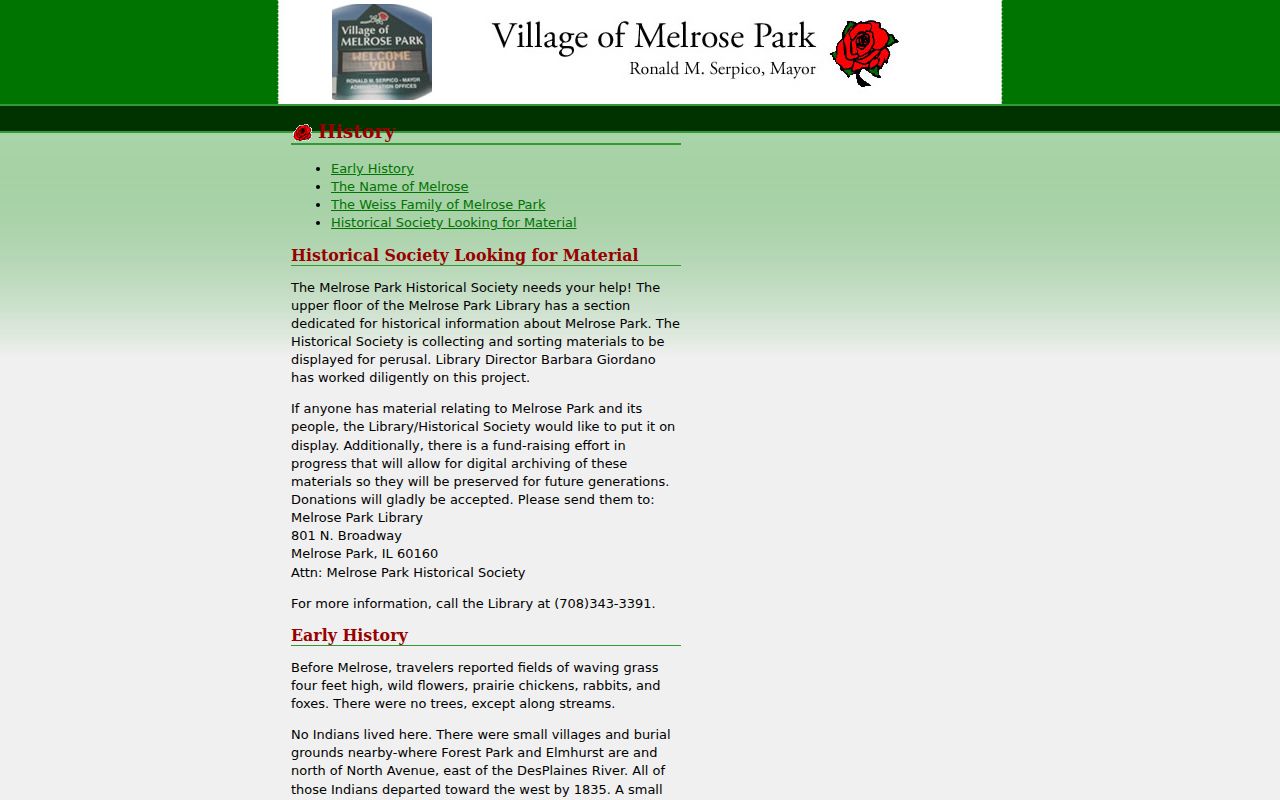
The Village page lists (708) 343-3391, while the current library uses (708) 649-7400 and the reference desk uses (708) 649-7485. Verify the current contact before visiting.
A vivid address trail survives at the same Broadway building. A 1937 Airmail mural was thought destroyed, then rediscovered after a former resident asked about it in 2007. The mural's civic-building story shows why old post-office, library, Village property, photo, and newspaper descriptions may all point to one place.
Melrose Park Directory Gaps at IRAD
The Illinois Regional Archives Depository supplies a date map when the city directory years run out. Cook County holdings include birth records from 1871 through 1915 with an index through 1916, outside-Chicago death certificates from 1878 through 1909 with an index from 1871 through 1916, and naturalization declarations from 1874 through 1929. Court indexes, coroner material, poll books, assessor books, and probate-related series have their own dates.
| Year | Research milestone |
|---|---|
| 1895 | Sanborn volume includes Melrose Park and Maywood-area sheets. |
| 1917 | First exact local directory year found in the inventories. |
| 1920-1927 | Documented combined Maywood and Melrose Park directory run. |
| 1950 | Most recent public federal census under the 72-year rule. |
| 2020 | Cook Recorder duties moved into the County Clerk. |
IRAD access is series by series through its catalog, repository, reading room, or research request. The inventory's “burnt case files” label for 1872 through 1904 does not explain the damage or survival. Ask the repository what index or substitute docket remains.
Map Melrose Park Directory Addresses
Sanborn maps and census schedules answer different questions. The Library of Congress Sanborn collection can show street names, house numbers, footprints, materials, water facilities, and business or industrial use. It does not establish ownership. A census can show a household and nearby names, but its OCR may miss a person. Browse enumeration-district maps and page images when the index fails.
Pair the sources: city directory entry, census household, Sanborn building, newspaper event, and deed or tax evidence. Keep the original Maywood or Melrose Park place wording. The PIN, legal description, township, and map sheet are safer bridges than silently modernizing an old address.
Name forms deserve the same care as addresses. Melrose Park's Italian-American institutions and its large Hispanic and foreign-born communities make initials, diacritics, compound surnames, married names, and translated given names useful search variants. These are search tactics, not assumptions about a person. Copy the spelling from each record and explain why two forms may refer to one household. A firm name or storefront can also appear beside a resident, so check a business line against a newspaper advertisement or recorded document before treating it as a personal address.
The fixed civic points on Broadway, Lake Street, North Avenue, 25th Avenue, and 27th Street can help orient an old entry. They do not settle a disputed house number. Where the directory wording and present map diverge, ask the Village or county GIS staff about plats and preserve the old form. No authoritative local street-renumbering crosswalk was found, which makes a dated map and legal description especially valuable.
A careful city directory citation retains the volume title, year, page, heading, exact entry, repository, and access date. Those details distinguish a catalog description from a local page that was actually inspected.